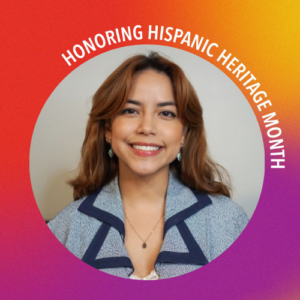
In celebration of National Hispanic Heritage Month, ACRP is pleased to share the following contribution from Estephanie Charria, RN, BSN, CCRC, a part-time Clinical Instructor at AdventHealth University who is currently enrolled in the Doctor of Nursing Practice program at the University of Central Florida. She has worked as a Registered Nurse and Clinical Research Coordinator II for AdventHealth in Orlando, is a member of the National Association of Hispanic Nurses, serves as a student ambassador for the Florida Nurse Practitioner Network, and is working part-time with a Transplant Progressive Care Unit.
For me, Hispanic Heritage Month is more than a celebration of where I come from. It is an opportunity to reflect on how my heritage has shaped the way I see healthcare, advocacy, and the people I have the privilege of serving.
I was born in Colombia and immigrated to the United States when I was three years old. I was raised in New York before eventually moving to Florida, and I am the first person in my family to attend college in the United States. Growing up between cultures taught me early that language is about much more than words. It can determine whether someone feels heard, whether they understand what is happening to their body, and whether they feel empowered to advocate for themselves.
I remember helping my mother navigate English as she became more comfortable advocating for herself. Even today, I see how easily medical terminology can become a barrier—not because someone lacks intelligence or interest in their health, but because healthcare has a language of its own. I have experienced this within my own family, and later, I began seeing the same barriers in the patients I cared for.
Those experiences followed me into nursing.
Recognizing and Addressing Healthcare Barriers
As a bedside nurse, I cared for many Spanish-speaking patients. Working in Florida, where Hispanic and Latino communities are a significant part of the population, I initially thought some of these barriers might be easier to overcome. But visibility does not automatically translate into access or equity.
I encountered patients who were unsure of their diagnoses, did not fully understand procedures they had undergone, or were unclear about what they needed to do after discharge to prevent complications. I also saw how easily clinical research could remain outside of the conversation. Patients who might have been eligible for a clinical trial, or who simply deserved to know that one existed, were not always presented with that opportunity.
These experiences were difficult to ignore because they were not abstract to me. I could see my family in some of these patients. I understood what it felt like to sit on the other side of a healthcare conversation and wonder whether you were really understanding what was being said.
Taking an Unexpected Career Path
Interestingly, my path into clinical research was not something I planned. I stumbled into research. A colleague approached me about an opportunity and told me that she thought I would be good at it—and that I might enjoy it. She apparently saw something in me that I had not yet recognized in myself. She was right. I fell in love with clinical research.
After spending several years in nursing, I became fascinated by the process of asking questions, generating evidence, and ultimately translating that evidence into better care. But just as importantly, I began to recognize how much representation mattered within research itself.
I realized there was value in having someone in the research environment who understood the community—not just professionally, but personally. Someone who understood the importance of family. Someone who could communicate in Spanish. Someone who knew that asking, “Do you understand?” is not necessarily the same as ensuring someone truly understands.
Creating a More Inclusive Research Environment
My experience is not unique. Hispanic and Latino communities remain underrepresented in clinical research, and barriers can include language, awareness, access, and mistrust shaped by experiences with the healthcare system and research. At the same time, research has shown that these barriers are not insurmountable. Community engagement, culturally and linguistically appropriate communication, and diverse research teams can all help create a more inclusive research environment.
That distinction matters to me.
I do not think the question should be, “How do we get more Hispanic patients into clinical trials?”
We should also ask, “Have we created a research environment where they feel invited, respected, understood, and valued?”
Trust cannot be demanded. It has to be built.
For communities that may approach healthcare and research cautiously, building trust requires more than translating a consent form. It requires listening, creating relationships, and taking the time to explain not only what a study is, but why it matters, what participation means, and how a participant’s voice contributes to the process. It also requires representation among the people conducting the research.
When a patient sees someone who looks like them, speaks their language, understands their culture, and can make a complicated research process feel approachable, it can change the conversation. It can turn an unfamiliar research environment into one that feels a little more human.
Pursuing New Goals
My career has since taken me back to the bedside and into doctoral education. I am currently pursuing my Doctor of Nursing Practice (DNP), and although I have stepped away from clinical research while focusing on school, research remains a fundamental part of why I chose this path. My experiences in clinical research showed me how powerful evidence can be—but they also showed me that evidence alone is not enough.
We need clinicians who understand the communities they serve. We need researchers who recognize that culture, language, family, and lived experience are not obstacles to research; they are important parts of the human experience that research is meant to understand. And we need people who can help translate evidence into practice.
My DNP journey is allowing me to continue building those skills while finding new ways to advocate for the communities I care about. I hope to bring together clinical practice, research, education, and advocacy in a way that helps make healthcare—and the research that shapes it—more accessible and representative.
Stepping into the Room
As I reflect on Hispanic Heritage Month, I think about the little girl who arrived in the United States from Colombia and grew up helping her mother navigate a language that was not yet her own. I never imagined that those early experiences would eventually influence my career in nursing, clinical research, and doctoral education. But perhaps that is what heritage does. It follows us. It shapes how we listen, how we advocate, and how we understand the people sitting across from us.
I believe we need more people from diverse backgrounds to bring those perspectives into clinical research—not because representation is a box to check, but because better research depends on understanding the people whose lives it hopes to improve.
To anyone who is passionate about health equity, curious about research, or wondering whether there is a place for you in this field: I hope you consider stepping into the room. You do not have to have the entire path figured out. I certainly didn’t. Sometimes someone else sees something in you before you see it in yourself.
There is still so much work to do to make clinical research more inclusive, representative, and accessible. But every conversation matters. Every relationship matters. Every person who chooses to bring their voice into the room matters. And sometimes, simply being there can be the beginning of change.
Edited by Gary Cramer