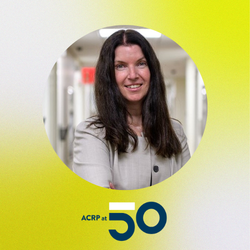
As the Association of Clinical Research Professionals (ACRP) celebrates its golden anniversary this year, we are pleased to continue our series of Q&A interviews, “Forecasts from the ACRP Fellows: Insights on the Future of Clinical Research as ACRP Turns 50.”
Our latest guest is Christina Brennan, MD, MBA, CCRC, FACRP.
Q: For 50 years, ACRP’s mission to advance excellence in clinical research has empowered professionals like you to lead the industry forward. What’s a defining moment in your career when you felt proud to contribute to that legacy?
A: While my journey of more than 21 years with ACRP has been rich with proud moments—from achieving certification in 2005, to serving on my local NY Metropolitan Chapter board for six years including serving as President, and then another six years on the ACRP Board of Trustees including serving as Chair in 2025—the defining moment that truly solidified my sense of contributing to ACRP’s legacy was my induction in 2025 as an ACRP Fellow.
Joining a distinguished group of more than 50 colleagues in this esteemed capacity felt like the culmination of my professional development journey and my dedication to the field. It wasn’t just a personal honor; it was a profound recognition that I was part of a collective, a professional family that ACRP has meticulously built and nurtured. This organization hasn’t just supported the clinical research industry; in many ways, it has created and defined the standards, ethics, and professional pathways that allow individuals like me to thrive.
To be acknowledged among peers who embody the excellence ACRP champions, and to continue to represent that standard, made me incredibly proud to contribute to the enduring legacy of an organization that has been my professional home and a cornerstone of our vital industry.
Q: Looking back on your experience in clinical research, what’s a lesson you’ve learned that points to how trials could be improved—whether in quality or efficiency? What changes would help make that improvement a reality, and how might ACRP play a role in supporting it?
A: The most impactful lesson I’ve learned is the critical importance of proactive, genuine patient engagement from the earliest stages of trial design, not just during recruitment. Too often, trials are designed primarily by scientists and clinicians, leading to protocols that can be burdensome, inconvenient, or simply unappealing to patients, directly impacting recruitment, retention, and data quality.
To improve this, we need to embed patient advisory boards, patient advocates, and even public stakeholders directly into the protocol development process. This means involving them in discussions about study endpoints, visit schedules, data collection methods, and even the language used in informed consent forms. Their insights can simplify protocols, enhance relevance, and significantly improve patient experience, leading to better compliance and more robust data.
ACRP can play a pivotal role by developing standardized frameworks and training modules for effective patient engagement. This includes best practices for establishing patient advisory groups, guidelines for integrating patient feedback into study design, and educational programs for investigators and study coordinators on how to communicate with and empower patients as true partners in research. By professionalizing this aspect of trial conduct, ACRP can elevate the quality and efficiency of trials across the board.
Q: As the clinical research enterprise faces unprecedented challenges like funding pressures, public engagement, and regulatory uncertainty, what’s your outlook on the current state and future prospects of the drug and device development industry?
A: My outlook is one of cautious optimism, tempered by a realistic understanding of the significant hurdles ahead. The current state is undoubtedly complex: funding pressures demand greater efficiency and demonstrable value, public engagement requires rebuilding trust and increasing transparency, and regulatory bodies are striving to adapt to rapidly evolving science and technology.
However, I believe we are also on the cusp of a golden era of innovation. Advances in personalized medicine, artificial intelligence (AI)–driven insights, real-world data integration, and decentralized trial methodologies offer powerful tools to address many of these challenges. The future prospects are bright for those willing to embrace change, prioritize patient centricity, and foster unprecedented collaboration across stakeholders—academia, industry, regulators, and patients themselves. We will see drug and device development become more targeted, efficient, and ultimately, more impactful. The fundamental human need for health solutions will continue to drive this industry forward, pushing us to innovate and overcome.
Q: Are there any other insights you’d like to share with our readers based on the trends you’ve been witnessing in the trenches in recent years?
A: I’ll start with the Blurring Lines of Traditional Roles: With the rise of decentralized trials and advanced technologies, the traditional roles of study coordinator, clinical research associate, and project manager are evolving. Professionals need to be more technologically adept, flexible, and capable of managing complex data streams and patient interactions remotely. Continuous upskilling is no longer optional.
Next I’ll note AI as an Augmentor, Not a Replacement: AI and machine learning are transforming everything from patient identification and protocol optimization to data monitoring and analysis. The trend is not that AI replaces human expertise, but rather augments it, freeing up researchers to focus on higher level strategic thinking, problem-solving, and patient interaction. Understanding how to leverage these tools effectively will be a core competency.
I’m also thinking about Workforce Development and Retention: The clinical research workforce is under immense pressure. Burnout, high turnover, and a talent gap are significant concerns. Investing in mentorship programs, clear career pathways, and fostering a supportive work environment are critical for sustaining the industry’s growth and ensuring we have the skilled professionals needed for future innovation.
These trends collectively point to a future where clinical research is more agile, inclusive, technologically sophisticated, and deeply rooted in the patient experience.
Further, through my leadership positions with ACRP, I found a unique opportunity to actively shape the direction of the organization. I was able to collaborate with dedicated peers to develop impactful professional development programs, expand networking opportunities, and ensure that our educational offerings remained at the forefront of clinical research best practices.
Seeing the tangible results of these efforts—witnessing members advance their careers, seeing new professionals find their footing, and knowing that we were collectively upholding the highest standards for the industry—filled me with immense pride. ACRP has truly been my professional home, providing not just certification and opportunities, but a platform to give back and ensure that future generations of clinical research professionals are equally empowered to lead the industry forward. Contributing to that enduring mission, year after year, has been the most gratifying aspect of my career with ACRP.
About Christina Brennan
Christina has devoted her career to the clinical research enterprise and currently serves as Northwell Health’s Senior Vice President of Clinical Research. Committed to the advancement of science and medicine, she has more than 26 years of extensive clinical research experience, including more than 21 years in management roles. She received the Christine Pierre Clinical Trials Lifetime Achievement Award from the Society for Clinical Research Sites (SCRS) in 2023. She is the Immediate Past Chair for the ACRP Board of Trustees and an active member of the Clinical Trial Transformation Initiative, a collaborative effort of Duke University and the U.S. Food and Drug Administration, where she sits on the executive and steering committees. She also sits on the oncology advisory board and technology site advocacy group with SCRS and is an active member of the Women in Bio organization and the American College of Healthcare Executives. She has authored chapters in textbooks, coauthored many manuscripts and abstracts, and presented at numerous scientific and research meetings. She is also an adjunct faculty member for Yeshiva University and CUNY YORK for the Masters of Science degrees in clinical research.
About the ACRP Fellows
Being named a Fellow of the Association of Clinical Research Professionals (FACRP) is a mark of distinction. ACRP’s Fellowship program recognizes those who have made substantial contributions to the Association and the industry at large, as evidenced by: ACRP certification and continuing education, leadership contributions to ACRP, and contributions to the field of clinical research.
Fellowship highlights excellence and commitment to ACRP, and is suitable for only a small, select number of clinical research professionals who are lauded as global leaders.
Edited by Gary Cramer