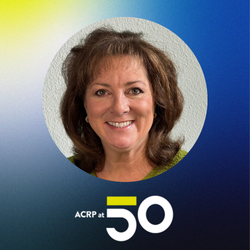
Editor’s Note: As the Association of Clinical Research Professionals (ACRP) celebrates its 50th anniversary this year, we are pleased to launch a series of Q&A interviews, “Forecasts from the ACRP Fellows: Insights on the Future of Clinical Research as ACRP Turns 50.”
Our first guest is Lynn D. Van Dermark, RN, BSN, MBA, RAC, FACRP.
Q: For 50 years, ACRP’s mission to advance excellence in clinical research has empowered professionals like you to lead the industry forward. What’s a defining moment in your career when you felt proud to contribute to that legacy?
A: My passion for Good Clinical Practice (GCP) training began early in my clinical research career, and I was fortunate to spend years teaching and coaching others. The audiences and locations changed, but the goal of making knowledge usable was always the same.
Working with ACRP as lead faculty in the 1990s expanded my perspective more globally. Training and clinical research shifted from a local activity to a worldwide effort, and ACRP was at the forefront of that transformation. It became less about improving one group and more about reaching and supporting clinical research professionals around the world and upholding best practice standards. Through the years I have worked on many ACRP committees and initiatives to lead the industry forward and continue to do so as a Fellow.
ACRP has led the way in shaping how thousands of professionals would learn, decide, and act. A defining moment for me is not tied to a single event, rather it is in realizing that something I helped lead will continue shaping how others learn and conduct clinical trials long after I am gone. I am a trainer at heart, and I’m proud to have contributed to ACRP’s legacy of not only building training systems but defining standards that elevate excellence in clinical research.
Q: Looking back on your experience in clinical research, what’s a lesson you’ve learned that points to how trials could be improved—whether in quality or efficiency? What changes would help make that improvement a reality, and how might ACRP play a role in supporting it?
A: I have learned that noncompliance rarely stems from lack of caring, it comes from systems that expect perfection from imperfect humans. Training is important, but it cannot overcome the pressures and complexity of real world work.
Quality improves when systems are designed around human limits: fewer steps, clearer decisions, guiding tools, and simpler processes. The question should not be “Why didn’t they follow the process?” but “Why was the process hard to follow?”
ACRP can continue leading by promoting best practices grounded in real human behavior, enabling both higher quality and greater efficiency.
Throughout 2026, ACRP will spotlight its extraordinary community through testimonials, video vignettes, editorial blogs, and at the Annual Conference. Clinical research professionals are invited to share their favorite ACRP memories for inclusion on the ACRP at 50 anniversary website.
Q: As the clinical research enterprise faces unprecedented challenges like funding pressures, public engagement, and regulatory uncertainty, what’s your outlook on the current state and future prospects of the drug and device development industry?
A: The clinical trial landscape is confronting real headwinds, but moments like this are where leadership and purpose matter most. In times of pressure, clarity becomes a competitive advantage and ACRP stands as a steady, trusted guide for research professionals around the world. Our industry is not in decline; it is evolving. Yes, we face funding constraints, regulatory uncertainty, and challenges in engaging the public. But these difficulties coexist with extraordinary innovation, powerful new technologies, and unprecedented opportunities to reimagine how research is conducted.
If we lean into what truly moves the field forward—such as high impact science, thoughtful use of technology, strong partnerships, and authentic collaboration with regulators and the communities we serve—we will not just weather the change ahead, we will shape it. The next decade holds remarkable potential, and with ACRP’s support, clinical researchers will be empowered not only to adapt but to excel with confidence.
Q: Are there any other insights you’d like to share with our readers based on the trends you’ve been witnessing in the trenches in recent years?
A: I’m energized by the updated ICH E6(R3) guideline for GCP from the International Council for Harmonization, because it raises the bar for our industry and brings smarter design, clearer expectations, and modern standards that genuinely strengthen how clinical research is conducted.
About Lynn D. Van Dermark
Lynn is Co-Founder and CEO of MedTrials, Inc., in Dallas, Texas, Past Chair of the ACRP Board of Trustees (2014), and an ACRP Fellow since 2019. She is also a Charter Member and Past President of the ACRP North Texas Chapter, served on the former ACRP Editorial Advisory Board (among other committees), and maintained her status as a Certified Clinical Research Associate through ACRP for more than 25 years.
About the ACRP Fellows
Being named a Fellow of the Association of Clinical Research Professionals (FACRP) is a mark of distinction. ACRP’s Fellowship program recognizes those who have made substantial contributions to the Association and the industry at large, as evidenced by: ACRP certification and continuing education, leadership contributions to ACRP, and contributions to the field of clinical research.
Fellowship highlights excellence and commitment to ACRP, and is suitable for only a small, select number of clinical research professionals who are lauded as global leaders.
Edited by Gary Cramer