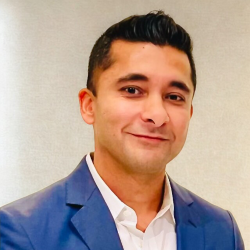
As experienced pharmaceutical industry executive Mo Ali settled into his volunteer duties as Chair of the ACRP Board of Trustees for 2026, a year in which the Association celebrates its 50th anniversary of service to its members and stakeholders, he took time to answer some questions about his experience in the clinical research enterprise, some of the challenges and opportunities facing it, and how ACRP can further its mission in a time of rapidly evolving technologies and processes.
Q: Can you share some highlights from your career journey that you believe will help you achieve your goals as 2026 Chair of the ACRP Board of Trustees?
A: I’ve spent roughly 25 years in this industry, and my career began at the site level as a clinical research coordinator (CRC), working primarily on dialysis and nephrology studies. I came into that role somewhat by chance. I had a strong interest in science but hadn’t yet found a clear professional path. Discovering clinical research—and, specifically, the coordinator role—was transformative for me.
Working directly with patients early in my career shaped how I view everything we do in drug development. Patients are ultimately the reason this industry exists. If that perspective is lost, then we’ve lost our way. Since those early days, I’ve had the opportunity to work across multiple large pharmaceutical organizations, but that foundational experience at the site level continues to guide my thinking.
Every decision I’ve made throughout my career—and continue to make—comes back to a few core questions: What does this mean for the patient? What burden does it place on them? What does it require of the site teams delivering the study on behalf of sponsors? That grounding has influenced not only how I approach leadership, but how I think about innovation, process design, and the future of clinical research.
Q: How did you first become involved with ACRP?
A: I became aware of ACRP more than a decade ago, initially through its reputation for education and training. What stood out to me was the Association’s focus on empowering site professionals—ensuring they have access to relevant knowledge, practical training, and an understanding of emerging trends that directly impact their work.
At that stage of my career, I wanted to learn more by listening directly to site professionals. I began attending ACRP events, sitting down with CRCs and other site representatives, and simply asking about their day-to-day experiences: what was working, what wasn’t, what had improved, and what they wished sponsors better understood.
Those conversations were invaluable. They helped me stay grounded as my roles increasingly focused on digital transformation, data, and artificial intelligence (AI). ACRP provided a forum where those broader strategic initiatives could be viewed through the lens of real-world site impact—and that perspective has stayed with me.
Q: What workforce and industry challenges are top of mind for you this year, and how can ACRP support its stakeholders in 2026?
A: One of my priorities is continuing to elevate ACRP’s visibility and influence across the industry. ACRP is well known for training, but it is increasingly positioned to help define what “good” looks like in clinical research—particularly at the site level—through standards, best practices, and thought leadership.
Over the past several years, I’ve seen meaningful progress in this direction. My hope is to further amplify that message so ACRP is recognized not only as an educational body, but as a trusted voice shaping the future of clinical research delivery.
Equally important is member advocacy. Word-of-mouth conversations—one professional to another—remain incredibly powerful. Encouraging members to share their experiences with ACRP, to recommend it to colleagues, and to engage in open dialogue strengthens the community far more effectively than any single digital campaign.
Finally, I want to hear more from our members. What support do they need? What’s working well? Where are the gaps? What new areas should we be exploring? That feedback is essential. ACRP is a volunteer-driven organization, and its strength depends on actively listening to the people it serves.
Q: Looking ahead, what do you see as some of the “next big things” in clinical research?
A: From my perspective, the promise of advanced technologies—particularly AI—is very real, but adoption has been uneven. Much of that is due to fragmentation: organizations operating in silos, defining similar data differently, and taking divergent approaches to solving common problems.
That said, I firmly believe AI and advanced analytics will empower organizations and sites to move faster and work more effectively than ever before. Today, there is a growing imbalance between the volume of research activity and the resources available to support it. Technology, when applied thoughtfully, can help close that gap—improving efficiency while maintaining a strong focus on patient care.
I’m optimistic about what this means for drug development overall. Advances in technology are already accelerating discovery, allowing organizations to assess assets more quickly and focus investment where it truly matters. Over time, this will shorten development timelines and bring effective therapies to patients sooner.
Ultimately, that’s what matters most. Faster access to treatments means more time, better quality of life, and more moments with loved ones. That impact far outweighs any individual technology implementation.
Q: Are there any final thoughts you’d like to share?
A: I see this moment as an opportunity for reinvention—both for our industry and for individuals working within it. New ways of working require new skills, new mindsets, and a willingness to continuously learn.
Early in my career, a manager once told me I operated with a sense of “emergency” rather than “urgency.” That came from curiosity—asking questions, challenging assumptions, and pushing to understand what might be missing. I still believe that mindset is essential.
Whether you’re just starting out as a CRC or are well established in your career, my advice is simple: keep asking questions. Stay curious. Use the tools available to you, including new technologies, to expand how you think and work. You may be surprised by the answers you uncover—and by how differently you begin to see the path forward.