
Clinical Researcher—August 2026 (Volume 40, Issue 4)
PEER REVIEWED
Inge Behroozfard Daraeikia, MPH; Kristi Prather, MPH; Elizabeth Bennett; Ashley Heath; Dr. Monica E. Lemmon, MD; Lindsey Spangler, JD; Dr. Geeta Swamy, MD
Independent oversight of research conduct is essential to protect human subjects’ rights and welfare, educate investigators on ethical practices, enhance the ethical review process, safeguard institutions from federal regulatory actions, and maintain public trust in medical research ethics committees.{1} Routine monitoring activities ensure studies are being carried out as intended, according to the approved study protocols and the tenets for Good Clinical Practice (GCP), while prioritizing the health and safety of the participants.{2,3} Ongoing monitoring also helps prevent research fraud, reduces questionable practices, facilitates early identification of protocol deviations, and supports the accurate and effective dissemination of research findings.{2}
Industry-sponsored and U.S. Food and Drug Administration–regulated research typically includes independent external monitoring requirements and associated resources. However, federal and foundation-funded projects may not have built-in processes for routine monitoring. The absence of structured monitoring processes can create risks for study participants as well as the research institution.{2}
To address this gap, Duke University created the Clinical Quality Management Program (CQMP), which provides a robust quality management (QM) framework for clinical research studies, including policies, procedures, and tools that allow clinical research units (CRUs) to effectively monitor without external oversight. The CQMP evaluates reported events from reviews and provides trends to leadership and relevant central offices to support communication, education, training, and research quality assurance.
The CQMP operates within Duke’s Office of Scientific Integrity, serving researchers across the university on matters related to integrity. Duke’s biomedical research is organized under CRUs, which are aligned by therapeutic area. These units provide operational homes with oversight responsibilities for studies within their portfolios.{4} Each CRU has a designated Research Practice Manager who oversees the operational aspects of clinical research within the CRU and facilitates the CQMP review process with their designated QM reviewers. The structure of clinical research at Duke allows the CQMP to operate in collaboration not only with the CRUs, but also with central units within the Schools of Medicine and Nursing that have oversight for clinical research, such as the institutional review board (IRB) and Duke Office of Clinical Research.
Ensuring research quality is critical to enhancing the rigor and reproducibility of human subjects’ research.{1} The development and implementation of an institutional-based research quality monitoring program require investment in resources and personnel. Here, we aim to describe the key components and implementation of a CQMP.
Methods
Clinical Quality Management Program (CQMP) Policy and Framework
Minimum standards for monitoring prospective consenting clinical research studies conducted at Duke are defined by the CQMP policy.{5} It outlines the various aspects of the monitoring workflow to ensure accurate and consistent execution of QM plan development and regulatory and participant chart reviews.
The CQMP policy begins with determining which studies require a QM plan based on the complexity, funding source, and protocol for monitoring by an external entity.{5,6} QM plans define the methodologies implemented for quality assurance throughout the clinical research process.{6} QM plans are required to be comprehensive and reflect applicable protocol, principal investigator (PI), sponsor, sponsor-investigator, CRU, and IRB requirements, while aligning with Duke policies and procedures, the International Council for Harmonization guideline for GCP, and other regulatory requirements.{3,5,6}
QM plans are developed by a trained QM reviewer within the CRU, who collaborates with the study team to include tailored language that accurately outlines study-specific procedures, study design, and risks. The assigned QM reviewer is also responsible for amending the QM plan throughout the study’s duration, especially when significant changes arise that may introduce additional risks. Before the study is given institutional approval, the CQMP cross-checks QM plans with the study’s IRB application and associated documentation to ensure alignment with the study design, unique study aspects, and minimum review frequency for its assigned complexity.
Complexity Assignment
The CQMP initially classifies the study’s complexity (High, Medium, Low) based on defined characteristics. Studies categorized as high complexity generally involve procedures or interventions that present moderate to high risks to participants or regulatory risks to the investigator or institution. The CRU leadership or PI can request to upgrade the complexity or provide additional information for re-evaluation if they believe the designation is not appropriate.
Regulatory and Participant Chart Review Requirements
With a risk-based monitoring approach in mind, the frequency of regulatory and participant chart reviews is determined by the study’s complexity, with higher risk studies requiring more frequent reviews. The policy also outlines the minimum number of participants to review at each monitoring visit. QM reviewers use their discretion to select participants based on study design and identify risks across the enrollment period, to achieve the maximally representative sample size. Participants previously reviewed may be re-selected in circumstances involving multiple encounters, re-consenting, or long-term outcomes. Only new study activities from the last review are evaluated for previously reviewed participants.
Additional risks may arise at the start of enrollment and during times of staff turnover. Therefore, in addition to the discretionary selection of participants, the policy requires review of the first three participants consented in the study, as well as the first three participants with whom a new study team member has significant interactions for research purposes.
Monitoring Tools and Trainings
The CQMP monitoring tools originated from the National Institutes of Health’s CQMP{6} and have been tailored for Duke’s program to enhance usability, reduce administrative burden, and improve workflow. These tools, including the Participant Chart Review Tool and Regulatory File Review Tool, guide the QM reviewer in monitoring studies and reporting deviations. Available as downloadable documents, these tools are applied to all studies, regardless of complexity, funding, or regulatory requirements. Internal policies, funding guidelines, and regulatory references are embedded within the tools to assist the QM reviewer in selecting applicable questions. The tools are periodically reviewed by CQMP and updated in accordance with evolving regulations and policies.
To ensure an experienced workforce, only individuals in an advanced role as a clinical research coordinator, clinical research nurse coordinator, regulatory coordinator, or research program leader are eligible for QM reviewer training.{7} Trained individuals must be independent of the research studies they review.{5,7} The CQMP provides education for QM reviewers in a variety of ways, including initial training, routine educational sessions, and one-on-one shadowing visits.
Initial training for new QM reviewers first includes a policy review, quality assurance overview, QM plan creation, and database demonstration, followed by a mock review for hands-on learning. Continuing education sessions and newsletters focus on explaining QM reviewers’ functions, improving clinical research quality, and providing a platform for QM reviewers across CRUs to engage and learn from each other. Individualized shadowing is a collaborative experience facilitated by the CQMP that provides QM reviewers with a non-punitive environment to seek advice and discuss study-related monitoring issues.
Establishing Timelines and Tracking Reviews
The CQMP uses specific tools to collect, track, and analyze data related to reviews. These include a clinical trial management system (CTMS),{8} SAS/STAT® software,{9} and the CQM database. The CQM database is managed through REDCap (Research Electronic Data Capture), a secure web-based software platform designed to support data capture for research studies, providing:
- an intuitive interface for validated data capture;
- audit trails for tracking data manipulation and export procedures;
- automated export procedures for seamless data downloads to common statistical packages; and
- procedures for data integration and interoperability with external sources.{10,11}
To initiate the scheduling of QM reviews, the enrollment date of the first participant is retrieved from the CTMS and entered in the CQM database, which automatically calculates the review periods and sets the required monitoring windows according to the frequency specified in the QM plan. QM reviews are entered by the QM reviewer in the CQM database and evaluated by the CQMP for completeness and adherence to the schedule of reviews. The CQMP verifies the quantity of participant reviews based on the CTMS enrollment numbers. Data queries are issued by the CQMP for missing or incorrectly entered information.
During the review process, QM reviewers enter details related to specific deviations in the CQM database, including actions for the study team to complete. The responses to assigned action items are automatically integrated into the CQM database for analysis and reporting purposes. For example, if any unreported adverse events (AEs), serious adverse events (SAEs), protocol deviations, or unanticipated problems requiring IRB and/or sponsor reporting are identified, the QM Reviewer will promptly notify the study team and ensure those events are reported appropriately. Once all deviations are documented as resolved, a final version of the monitoring report is shared with the PI, study coordinators, and RPM.
Root Cause Analysis and Action Plans
The QM reviewer is responsible for assessing the need for a Corrective and Preventive Action (CAPA) plan to address and mitigate recurrence of deviations identified during QM reviews, ensuring the recommended plan was developed, documenting the plan including a summary of the root cause analysis (RCA) findings and actions in the CQM database, and assessing completion and the effectiveness of the actions. The CQMP continues to offer training, coaching, and co-facilitation to support and build capacity within CRUs to facilitate effective and efficient RCA as part of the CAPA planning process.
Analysis and Reporting
Given the centralized nature of the CQM database, the CQMP can export and analyze data across studies and CRUs.{9} Data are analyzed on an ongoing basis for data management and trending purposes. This approach provides a comprehensive evaluation of CQMP activities, strengthening the program’s ability to drive continuous improvement and informed decision-making.
The CQMP produces and shares a monthly report with each CRU that includes review due dates, comments about compliance or noncompliance, and review-specific information, as needed. Reports containing high-level summaries on QM plans and review deviations are disseminated to CRU leaders quarterly and institutional leadership annually to help maintain transparency and improve quality.
The summary statistics presented in this paper were generated and analyzed using SAS software version 9.4.{9}
Results
There were 627 studies requiring a QM plan from fiscal year (FY) 2020 (July 2019–June 2020) through FY 2024. The majority (60%) were assigned low complexity, followed by medium (27%) and high (13%). Almost half were federally funded (49%), with the remaining studies representing a mix of foundation (18%), industry (15%), internal (13%), and other (5%) funding sources.
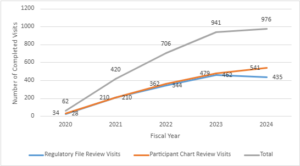
A total of 3,105 QM reviews were conducted, with a steady increase each FY (see Figure 1). During this timeframe, 36 CAPA plans were submitted, reflecting proactive efforts to strengthen documentation practices. Primary areas of focus included informed consent–related documentation (31%), participant eligibility verification (28%), and improvements in staff training records (19%).
Figure 1: QM Reviews Conducted by Review Type and Fiscal Year
Since FY 2020, an average of 15 individuals completed QM reviewer training each year for a total of 75 individuals, with the majority becoming active QM reviewers in their CRU. The median number of QM reviews conducted per person over the past five years was 13.5, with reviews per person ranging from one to 172, highlighting substantial variation in reviewer activity. While some individuals contributed disproportionately, the overall reviewer pool remained relatively consistent in recent years.
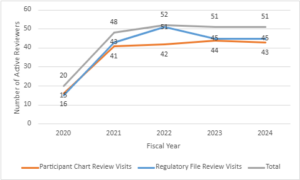
From FY 2021 through FY 2024, the number of active QM reviewers ranged from 48 to 52 annually, averaging just more than 50 per year (see Figure 2). FY 2020 serves as a baseline year, with notably fewer reviewers. By FY 2021, that number more than doubled to 48 and remained stable.
Additionally, 13 QM reviewers across 24 units participated in one-on-one shadowing visits, selected at the discretion of the CQMP using a risk-based approach, such as trend analysis or requests from CRU leadership. The visits focused on reinforcing existing CQMP policies and best practices, providing hands-on training with monitoring tools and templates, developing targeted QM skills, and addressing complex regulatory documentation issues. These interactions supported QM reviewer development and aided in the generation of new tools and templates to enhance the review process.
Figure 2: Active QM Reviewers by Review Type and Fiscal Year
Discussion
As the regulatory environment becomes more complex, understanding the resources required for a robust QM program is essential.{1} Our data over time demonstrate an expanding portfolio with a large cohort of QM reviewers, a steady increase in completed reviews, and the infrastructure and resources needed to support implementation.
At the start of the program, approximately 146 individuals attended CQMP training to familiarize themselves with the new policy and ensure sufficient implementation and oversight. As the CQMP became streamlined and procedures related to roles and responsibilities were better understood, the need for large-scale training was no longer necessary.
Over time, active QM reviewers likely developed greater confidence in managing the CQMP policy requirements and assessing risks to determine whether reviews should be conducted more or less frequently. For example, the plateau observed in FY 2024 (Figure 1) may suggest a stabilization in the number of studies requiring ongoing review.
By systematically assessing risk, QM reviewers can optimize monitoring efforts, ensuring resources are prioritized effectively while maintaining study integrity. However, sustaining a QM program requires ongoing investment and adaptability amid an evolving regulatory environment.{1} To ensure continued growth among QM reviewers, the CQMP has offered ongoing education and training opportunities related to identifying reportable events. These initiatives not only enrich QM reviewers’ skills, but drive discussions around program improvements, such as updates to monitoring tools and the development of ongoing educational efforts. One-on-one shadowing visits have shown themselves to be particularly valuable by strengthening relationships between the CQMP and QM reviewers, resulting in reviews of higher quality.
The CQMP has delivered numerous workshops, presentations, and training sessions to promote CAPA plan usage, while respecting the autonomy of QM reviewers and CRUs in determining when these tools are necessary. These training opportunities have been extended to diverse audiences, ranging from QM reviewers to CRU directors and the broader research community, covering topics from introductory concepts to detailed methodologies while integrating restorative practices and addressing the human element during the RCA process. This initiative aims to foster a culture across the clinical research landscape that embraces RCA and CAPAs as proactive, non-punitive tools for improving quality, preventing issues, and strengthening research integrity.
Adoption of the CQMP has improved processes for identifying, resolving, and reporting adverse events and deviations to the Duke University Health System IRB, supporting both regulatory compliance and participant safety. As the CQMP continues to mature, it aims to support research quality through enhanced risk assessment during the design phase, increased uptake of routine RCAs and CAPA plans to address areas in need of improvement, and novel strategies to facilitate a risk-based approach to monitoring. The knowledge gained from implementing the CQMP will help shape a long-term strategy to improve the effectiveness of QM programs in other academic research settings.
References
- Earp BD, Savulescu J. 2013. Special “Editor’s Choice” issue of the Journal of Medical Ethics now online. Journal of Medical Ethics 39(4):236. https://doi.org/10.1136/medethics-2016-103694
- Akello M, Coutinho S, N-Mboowa MG, Bukirwa VD, Natukunda A, Lubyayi L, Nabakooza G, Cose S, Elliott AM. 2020. Continuous research monitoring improves the quality of research conduct and compliance among research trainees: internal evaluation of a monitoring programme. AAS Open Research 3:57. https://doi.org/10.12688/aasopenres.13117.1
- International Council for Harmonisation. 2025. ICH Harmonised Guideline for Good Clinical Practice E6(R3). https://database.ich.org/sites/default/files/ICH_E6%28R3%29_Step4_FinalGuideline_2025_0106.pdf
- Snyder DC, Brouwer RN, Ennis CL, Spangler LL, Ainsworth TL, Budinger S, Mullen C, Hawley J, Uhlenbrauck G, Stacy M. 2016. Retooling institutional support infrastructure for clinical research. Contemporary Clinical Trials 48:139–45. https://doi.org/10.1016/j.cct.2016.04.010
- Duke Health. 2024. Clinical Quality Management Plans Policy.
- National Institute of Allergy and Infectious Diseases. Clinical Quality Management Plan. U.S. Department of Health and Human Services. https://www.niaid.nih.gov/research/dmid-clinical-quality-management
- Deeter C, Hannah D, Reyes C, Mack ME, Stroo M, Freel SA, Brouwer RJN, Gaudaur HE, Doughty AL, Snyder DC. 2020. Professional development for clinical research professionals: Implementation of a competency-based assessment model. Journal of Research Administration (51(2):15–40. https://eric.ed.gov/?id=EJ1293035
- OnCore Clinical Trial Management System (CTMS). https://www.advarra.com/sites/ctms/oncore/
- SAS Institute Inc. 2024. SAS/STAT® 9.4 User’s Guide.
- Harris PA, Taylor R, Thielke R, Payne J, Gonzalez N, Conde JG. 2009. Research electronic data capture (REDCap): A metadata-driven methodology and workflow process for providing translational research informatics support. Journal of Biomedical Informatics 42(2):377–81. https://doi.org/10.1016/j.jbi.2008.08.010
- Harris PA, Taylor R, Minor BL, Elliott V, Fernandez M, O’Neal L, McLeod L, Delacqua G, Delacqua F, Kirby J, Duda SN, REDCap Consortium. 2019. The REDCap consortium: Building an international community of software partners. Journal of Biomedical Informatics 95:103208. https://doi.org/10.1016/j.jbi.2019.103208

Inge Behroozfard Daraeikia, MPH, (inge.behroozfard@duke.edu) is a Research Project Manager with the Office of Scientific Integrity’s Clinical Quality Management Program at Duke University in Durham, N.C.
Kristi Prather, MPH, is the Director of Research Initiatives with the Office of Scientific Integrity at Duke University in Durham, N.C.
Elizabeth Bennett is a QA and Regulatory Compliance Associate with the Office of Scientific Integrity’s Clinical Quality Management Program at Duke University in Durham, N.C.
Ashley Heath is a Research Project Planner with the Office of Scientific Integrity’s Clinical Quality Management Program at Duke University in Durham, N.C.
Dr. Monica E. Lemmon, MD, is an Associate Professor of Pediatrics and Population Health Sciences and the Associate Dean for Scientific Integrity at the Duke University School of Medicine in Durham, N.C.
Lindsey Spangler, JD, is the Associate Dean with the Office of Scientific Integrity at Duke University in Durham, N.C.
Dr. Geeta Swamy, MD, is the Associate Vice President for Research and Executive Vice Dean for Clinical Sciences and Research Administration at Duke University in Durham, N.C.