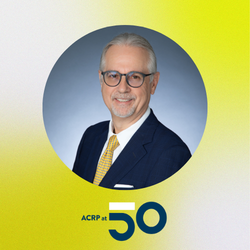
As the Association of Clinical Research Professionals (ACRP) celebrates its golden anniversary this year, we are pleased to continue our series of Q&A interviews, “Forecasts from the ACRP Fellows: Insights on the Future of Clinical Research as ACRP Turns 50.” Our April guest is David J. Morin, MD, FACP, CPI, FACRP.
Q: For 50 years, ACRP’s mission to advance excellence in clinical research has empowered professionals like you to lead the industry forward. What’s a defining moment in your career when you felt proud to contribute to that legacy?
A: As an individual effort, in 2018, the DIA Journal published “Therapeutic Innovation and Regulatory Science,” the first in a series of articles I wrote on a novel methodology for measuring the impact of protocol complexity on research productivity. I was very honored to see the article included in a Sponsored Special Section by TransCelerate BioPharma in 2019.
As a collective effort, in 2016, I assisted ACRP in creating the “Clinical Research Coordinator Boot Camp,” a 40-hour immersive course taught onsite, and in 2018 the “Principal Investigator Competency Training Program,” a nine-hour course. For several years I served as the principal instructor for both.
Q: Looking back on your experience in clinical research, what’s a lesson you’ve learned that points to how trials could be improved—whether in quality or efficiency? What changes would help make that improvement a reality, and how might ACRP play a role in supporting it?
A: Our common goals as researchers are to minimize risk and maximize benefits to our study population, and to provide quality data. Efficiency is adversely affected by increased protocol complexity, expanded therapeutic options and exclusion criteria, complicated regulatory requirements, shifts in study timelines and amendments, and persistent societal mistrust. While quality measures are driven by these common goals, they may lead to increasing protocol complexity and regulatory burdens. These headwinds result in higher costs and efforts for both sites and sponsors.
How can this be improved? Beyond measures at the federal level to streamline processes, I would like to see sponsors consult with highly experienced sites during the protocol development process. This would help to balance the sponsor’s desire to obtain ancillary study data with its adverse impact on the site as they follow the protocol. It would also make clear to all the perspective of sites on the issue of how new quality mandates may result in adverse unintended consequences on recruitment and site workload. ACRP can help bring these groups together to explore strategies to improve the process.
Throughout 2026, ACRP will spotlight its extraordinary community through testimonials, video vignettes, editorial blogs, and at the Annual Conference. Clinical research professionals are invited to share their favorite ACRP memories for inclusion on the ACRP at 50 anniversary website.
Q: As the clinical research enterprise faces unprecedented challenges like funding pressures, public engagement, and regulatory uncertainty, what’s your outlook on the current state and future prospects of the drug and device development industry?
A: I’m optimistic overall. Artificial intelligence is expanding our understanding of the molecular basis for disease and drug development. But the cost of new therapeutics remains a concern in terms of how it limits access and leads to higher insurance prices. However, it’s encouraging to see recent efforts addressing some of the root causes of disease by focusing on improving lifestyle and diet.
About David J. Morin
First active as an ACRP Member in 2005 and as an ACRP Fellow in 2018, David served as Chair of the ACRP Board of Trustees in 2022 and as a volunteer cyclist for several ACRP Rally4Researchers events. He has been a principal investigator on hundreds of studies since 1989. He became a Certified Principal Investigator (CPI) in 2007 and a Credentialed Clinical Research Trainer for ACRP in 2010. He received the “Outstanding Physician Leadership” award from ACRP and the Academy of Physicians in Clinical Research in 2012. He is Director of Research at Holston Medical Group in Kingston, Tenn., since 2008, a published author and speaker, and a past member of ACRP’s CPI Global Exam and Awards and Recognition Committees. He received his pharmacy degree with High Distinction at the University of Rhode Island and his MD with Honors at the University of Vermont and completed his residency training in Internal Medicine at the University of Virginia.
About the ACRP Fellows
Being named a Fellow of the Association of Clinical Research Professionals (FACRP) is a mark of distinction. ACRP’s Fellowship program recognizes those who have made substantial contributions to the Association and the industry at large, as evidenced by: ACRP certification and continuing education, leadership contributions to ACRP, and contributions to the field of clinical research.
Fellowship highlights excellence and commitment to ACRP, and is suitable for only a small, select number of clinical research professionals who are lauded as global leaders.
Edited by Gary Cramer