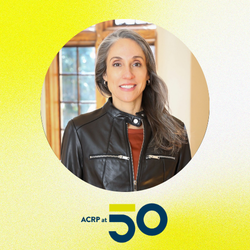
As the Association of Clinical Research Professionals (ACRP) celebrates its golden anniversary this year, we are pleased to continue our series of Q&A interviews, “Forecasts from the ACRP Fellows: Insights on the Future of Clinical Research as ACRP Turns 50.”
Our May guest is Erika Stevens, MA, FACRP.
Q: For 50 years, ACRP’s mission to advance excellence in clinical research has empowered professionals like you to lead the industry forward. What’s a defining moment in your career when you felt proud to contribute to that legacy?
A: The pivotal event in my 30-year tenure evolved over more than a decade. In 2012, I began my campaign for recognition of the clinical research industry as a profession—first, by presenting a talk on the professionalization of clinical research coordinators (CRCs) at the University of Rochester.{1} Later that year, “The Critical Need for Academic Health Centers to Assess the Training, Support, and Career Development Requirements of Clinical Research Coordinators: Recommendations from the Clinical and Translational Science Award Research Coordinator Taskforce” call to action publication further supported the much-needed clarity of CRC professional standards.{2}
By 2015, ACRP’s Clinical Researcher published “The Professionalization of Clinical Research Coordinators,” aligned to the work of the Joint Task Force for Clinical Trial Competency and setting the stage for the recognition need.{3} Six years later, in 2021, a follow-up article on “Are Clinical Research Coordinators a Recognized Profession?” highlighted the occupational awareness gap on the part of the U.S. Bureau of Labor Statistics (BLS).{4}
In 2024, ACRP filed a detailed comment letter to the BLS, advocating for a new detailed occupation code for the role of Clinical Researcher under the 29–0000 Healthcare Practitioner and Technical Occupations code.{5} The review and revision process is pending completion by 2027, with anticipated implementation in the 2028 reference year. If all goes well for our request, it will mark a momentous event and major step forward for clinical research industry recognition, and I am honored to be part of this legacy.
Q: Over the past five decades, ACRP has evolved alongside seismic shifts in the research landscape—from paper‑based processes to trials that are impacted by artificial intelligence (AI). How have those transformations impacted your own work, and how has ACRP helped you adapt?
A: In addition to vast technological changes, such as process automation, multi-system integration, and AI, clinical research regulatory changes have called for oversight, agility, and accountability, as reflected in two ICH E6 revisions, the Health Insurance Portability and Accountability Act, the revised Common Rule, and the General Data Protection Regulation. ACRP’s real-time responses to such changes leverage industry leaders and regulatory advisors, such as found in the U.S. Food and Drug Administration (FDA), to provide solutions for operational success.
With the shift from antiquated, largely manually based, activities to evolved, tech-enabled capabilities, ACRP has supported member comprehension through the development of critical-to-performance white papers and reports.{6} Clinical trial execution is exponentially faster and more agile than it once was, and ACRP is the leader in guiding practice updates for early member adoption. Change is the one constant in our industry. ACRP remains at the forefront in developing thought leadership, training, and workforce development content to support these critical changes.
Q: As the clinical research enterprise faces unprecedented challenges like funding pressures, public engagement, and regulatory uncertainty, what’s your outlook on the current state and future prospects of the drug and device development industry?
A: In 2025, a total of 46 new drugs were approved by the FDA—just slightly lower than prior years—which averaged 50.{7} The largest industry shifts underway include calls for data-intensive and evidence-based methods, which improve quality. Research results derived through credible evidence generation bolster industry efficacy.
Tech-agile innovators will likely continue to drive the marketplace for research and development, coupled with mergers and acquisitions (M&A). In 2025, life sciences companies spent $240 billion on M&A.{8} The need for oncology research alone continues to grow, with estimates reporting more than 100 different types of cancer under study and approximately 1,700 individuals dying per month from cancer in the United States.{9} The need for ongoing clinical development to treat patients and improve health outcomes remains a significant priority.
Q: Are there any other insights you’d like to share with our readers based on the trends you’ve been witnessing in the trenches in recent years?
A: A significant risk to clinical research delays continues to land on the outsourcing relationship and agreement structure for conducting clinical trials. While the industry shift away from transactional models toward performance-based models suggests Functional Service Providers or Functional Service Outsourcing improve bottlenecks, they fall short of a formal collaborative relational approach. A Vested® relational model approach to outsourcing drives mutual benefits for the sponsors and clinical research service providers through aligned shared outcomes, shared risk, and shared reward reinforced with a joint governance approach.{10}
References
1. Stevens E. 2012. The Professionalization of Research Coordinators. Presented at the University of Rochester Medical Center, 4th Annual Half-Day Workshop for Research Coordinators, Rochester, N.Y.
2. Speicher L, Fromell G, Avery S, Carlson L, Stevens E, Toms M. 2012. The Critical Need for Academic Health Centers to Assess the Training, Support, and Career Development Requirements of Clinical Research Coordinators: Recommendations from the Clinical and Translational Science Award Research Coordinator Taskforce. Clinical Translational Science 5(6):470–5.
3. Stevens E, Daemen E. 2015. The Professionalization of Research Coordinators. Clinical Researcher 29(6):26–31.
4. Stevens E, Wool L. 2021. Are Clinical Research Coordinators Recognized as Professionals? Clinical Researcher 35(2). https://acrpnet.org/2021/03/17/are-clinical-research-coordinators-recognized-as-professionals
5. ACRP. Docket ID (BLS-2024-0001). Standard Occupational Classification (SOC) – Updates for 2028. https://acrpnet.org/wp-content/uploads/2024/11/ACRP_BLS-Submission-Final-Submission-2-.pdf?_zs=WBjld&_zl=EIJJ4
6. https://acrpnet.org/insights/white-papers
7. FDA. Novel Drug Approvals. https://www.fda.gov/drugs/novel-drug-approvals-fda/novel-drug-approvals-2025
8. EY. EY Firepower report: life sciences deal making – trends in 2026. https://www.ey.com/en_gl/firepower-report
9. Siegel RL, Kratzer TB, Giaquinto AN, Sung H, Jemal A. 2025. Cancer statistics, 2025. CA Cancer J Clin 75(1):10–45. doi:10.3322/caac.21871
10. https://www.vestedway.com/what-is-vested/
About Erika Stevens
An ACRP Fellow since 2022, Erika leads research transformation advisory and assurance services, advising process improvement initiatives for productivity, quality, and efficiency in operations, cross-functional relationships, administration, manufacturing, and compliance. In her 30 years of research and development experience, she has served as Vice President Research, Senior Managing Director, Director CTO, Director of Clinical Research, and Director of Research Operations for various organizations. As Director, Clinical Research Experience, Erika leads the Academic Clinical Research Management track for the MS in Clinical Research Management program at Rutgers School of Health Professions. She also served as Chair of the ACRP Board of Trustees in 2021 and as a two-term Chair of the former Editorial Advisory Board for ACRP’s Clinical Researcher journal. Her published work appears in a variety of peer-reviewed journals, including the American Journal of Obstetrics & Gynecology, The Monitor, Clinical Researcher, Regulatory Focus, Applied Clinical Trials, Clinical and Translational Science, Journal of Mental Health and Aging, Source, and Research Methods. She holds her BA from the University of Vermont and MAs from Case Western Reserve University (CWRU) and Temple University. She also holds a Graduate Certificate in Gerontology from CWRU and an On-Line Teaching Certificate from Rutgers University.
About the ACRP Fellows
Being named a Fellow of the Association of Clinical Research Professionals (FACRP) is a mark of distinction. ACRP’s Fellowship program recognizes those who have made substantial contributions to the Association and the industry at large, as evidenced by: ACRP certification and continuing education, leadership contributions to ACRP, and contributions to the field of clinical research.
Fellowship highlights excellence and commitment to ACRP, and is suitable for only a small, select number of clinical research professionals who are lauded as global leaders.
Edited by Gary Cramer