
Clinical Researcher—October 2026 (Volume 40, Issue 5)
PEER REVIEWED
Marc Wartenberger
In the world of clinical trials, the question isn’t if you’ll face an inspection, it’s when. Regardless, if you are a site, sponsor, or contract research organization (CRO), maintaining inspection readiness isn’t just about compliance; it’s about protecting participant safety and ensuring data integrity. Whether this is your first inspection or your twentieth, the fundamentals remain critical, while advanced strategies can provide competitive advantages for seasoned organizations. Let’s explore what it takes to confidently answer “yes” when that knock on the door comes, regardless of your experience level.
What is Inspection Readiness?
Inspection readiness is an ongoing state of preparedness that ensures adherence to regulatory frameworks, including ICH E6(R3) (the International Council for Harmonization’s guideline for Good Clinical Practice [GCP]), U.S. Food and Drug Administration (FDA) regulations (21 CFR Parts 11, 50, 54, and 312 in the Code of Federal Regulations), the European Union Clinical Trials Regulation No 536/2014, the General Data Protection Regulation (GDPR), Medicine and Healthcare products Regulatory Agency (MHRA) GCP requirements in the United Kingdom, World Health Organization (WHO) GCP guidelines, and other applicable standards. It’s the foundation that protects participant safety and well-being while maintaining compliance with study protocols.
The stakes are high. According to FDA inspection data from 2024, protocol noncompliance accounts for 55.4% of investigator citations, while inadequate case history records represent 24.1% of findings.{1} These statistics underscore a critical truth: inspection readiness is essential for maintaining data integrity, avoiding costly delays, and ensuring participant safety. Straying from protocol heightens the risk of incomplete and inconsistent data, longer-than-expected timelines, and potentially unsafe conditions for the people who matter most: the study participants.
Understanding the Inspection Process
While inspection procedures vary by regulatory authority, several key elements remain consistent:
- Formal notification from the regulatory authority announcing the upcoming inspection
- Opening meeting to establish scope and set clear expectations
- Document requests made before, during, or after the inspection
- System access requests ranging from over-the-shoulder viewing to direct access through dedicated inspector accounts
Understanding this process helps organizations prepare systematically rather than scrambling when notification arrives.
What Actually Happens During an Inspection
Day 1: The Opening Meeting (Usually 30–60 minutes)
The inspector(s) will arrive and request a conference room or an adequate alternative for an opening meeting. They’ll present their credentials (for FDA inspectors, this would be the Form FDA 482), explain the scope and purpose of the inspection, and request a list of key personnel. This isn’t an interrogation; it’s an information-gathering session. The inspector is assessing your organization’s preparedness and cooperation level.
- What to expect: Questions about your organizational structure, ongoing studies, and general procedures. They may request an overview of your electronic systems and ask for a facility tour.
- Your role: Be professional, cooperative, and factual. Do not volunteer information beyond what’s asked, but answer completely and honestly.
Days 1–3: Document Review and System Access
Inspectors will request specific documents and electronic system access. They work systematically through study records, focusing on source document verification, protocol compliance, and data integrity. They’re looking for consistency between what you say you do (procedures) and what you actually do (records).
- What to expect: Requests for subject files, training records, protocol deviations, adverse event reports, and investigational product accountability. They will want to see your electronic systems in action and may request read-only access.
- Your role: Provide requested documents promptly and accurately. Designate specific staff to work with inspectors. Avoid “too many cooks in the kitchen.” Delegation is key.
Final Day: Closing Meeting
If the inspector identifies issues, findings will be discussed and may result in a Form FDA 483 (list of inspectional observations, in the FDA’s case). Receiving a formal observation letter should not be seen as a failure; it is an opportunity to demonstrate how well you can address their concerns.
The Technology Advantage: Why Electronic Systems Matter
The days of rifling through filing cabinets and binders during inspections are numbered. Electronic systems have transformed inspection readiness from a logistical nightmare into a streamlined process.
Consider a common inspection request: An inspector asks for all adverse event reports from the past six months. Centralized electronic systems support faster retrieval, improved traceability, and clearer audit trails compared to fragmented paper systems.
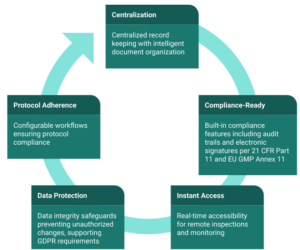
Electronic systems deliver clear advantages (see Figure 1).
Figure 1: A Centralized, Compliance-Ready Data Management Cycle That Ensures Protocol Adherence, Data Protection, and Instant Access for Regulated Environments
Principal Investigator Oversight in the Digital Age
ICH E6(R3) places renewed emphasis on principal investigator (PI) oversight, particularly in trials using electronic systems and decentralized approaches.{2} The PI must maintain ultimate responsibility for trial conduct while leveraging technology to enhance oversight capabilities.
Key PI oversight responsibilities include:
- Direct access to all trial data: Electronic systems must provide PIs with comprehensive, real-time visibility into all trial-related activities.
- Delegation documentation: Documentation of delegation should be proportionate to the significance of the trial-related activities.
- Deviation monitoring: Systematic review of deviations with particular emphasis on important protocol deviations (as determined by the sponsor).
- Safety oversight: Real-time access to adverse event reporting and safety signals.
Site Quality Control
Beyond the day-to-day regulatory compliance, sites must implement robust quality control processes that can prepare organizations for an inspection at a moment’s notice:
- Internal audits and regular self-assessments developed with regulatory expectations in mind prepare organizations for the rigor of an inspection.
- Electronic systems enhance PI oversight by providing dashboard views, automated alerts for protocol deviations, and comprehensive audit trails that support regulatory requirements.
- Quality Metrics Monitoring:
- Protocol deviation rates
- Query resolution times
- Consent form completion rates
- Adverse event reporting timeliness
- Quality Metrics Monitoring:
IRB Inspection Considerations
Institutional review boards (IRB) face unique inspection challenges that require specific preparation:
- IRB Meeting Documentation: Complete records of IRB meetings, including attendance, deliberations, and voting records, must be readily accessible.{3}
- Continuing Review Processes: Documentation of ongoing safety monitoring, annual reviews, and modification approvals.
- Member Qualifications: Current CVs, conflict of interest declarations, and training records for all IRB members.
- Communication Records: Documentation of all communications with investigators, sponsors, and regulatory authorities.
Electronic IRB management systems can streamline these processes while ensuring comprehensive audit trails.
Embracing the Regulatory Evolution
The regulatory landscape has evolved dramatically, particularly following the pandemic. The FDA’s Remote Regulatory Assessment guidance and ICH E6(R3) demonstrate regulators’ embrace of technology and risk-based approaches.
Key principles from ICH E6(R3) that support technology adoption:
- Media neutrality: Choose the electronic system that works best for your organization
- Flexibility and innovation: Leverage wearables, remote monitoring, and novel approaches
- Proactive quality: Build quality into processes from the start
- Data governance: Ensure responsible data collection, storage, and access in compliance with GDPR, where applicable
- Risk proportionality: Balance oversight with operational efficiency
As Jason Wakelin-Smith from MHRA noted at a symposium of the FDA, MHRA, and Health Canada in 2024{4}: “It is time for sponsors to adopt risk proportionality knowing that there is support from the regulators for its use.”
The Eight Pillars of Inspection Readiness
True inspection readiness requires excellence across eight critical areas:
1. Regulatory Compliance
Maintain adherence to FDA regulations (21 CFR Parts 11, 50, 54, and 312), European Medicines Agency guidelines, MHRA GCP requirements, WHO GCP guidelines, ICH E6(R3), and other applicable frameworks. This isn’t just about knowing the regulations, it’s about demonstrating consistent application, especially when it comes to electronic systems:
- Validation Requirements: All electronic systems must undergo a risk-based validation to demonstrate fitness for use. The level of risk of a system is directly tied to the information it holds and what the system is used for. For example, an electronic system that manages patient recruitment data should face a different level of scrutiny than an electronic source tool or an adverse event reporting system.
- Furthermore, ask your system vendor what information and documentation regarding system validation they can share with you. Not every organization has an internal information technology (IT) department or systems validations experts. Leverage what validation documentation is available and, at the very least, formally document how this system is fit for use.
- Access Control: Implementation of role-based access controls ensuring only authorized personnel can access specific systems and data.
- Audit Trail Integrity: Comprehensive logging of system activities and associated metadata to ensure the integrity of trial data (including user actions, data changes, and relevant system events).
- Data Migration: Documented procedures for data transfer between systems, ensuring data integrity throughout the process.
2. Comprehensive Documentation and Data Integrity
Keep complete, accurate, and current records, including investigator site files, source documents, and case report forms in accordance with 21 CFR Part 312 requirements. Documentation should tell the complete story of your trial.
Electronic documentation must meet higher standards than paper equivalents while providing enhanced capabilities. This is where ALCOA++ principles in electronic systems apply:
- Attributable: Electronic signatures and user identification exceed paper capabilities
- Legible: Consistent formatting and searchable text eliminate handwriting issues
- Contemporaneous: Automated timestamps provide precise recording times
- Original: Electronic originals with complete metadata vs. paper copies
- Accurate: Built-in validation rules prevent common data entry errors
- Complete: Mandatory field requirements ensure completeness
- Consistent: Standardized formats across all entries
- Enduring: Electronic backup and archival systems
- Available: Instant retrieval capabilities for regulatory review
- Traceable: Data can be traced from creation through the entire lifecycle
3. Training and Delegation
Ensure all staff are properly trained with documented records and clear delegation logs per 21 CFR Part 312. Every team member should understand their responsibilities and limitations.
Training should include but is not limited to:
- Protocol-specific training (if applicable)
- Training on electronic systems
- Site-specific and organizational policies and standard operating procedures
- Industry-specific training such as GxP training for good practices and data privacy, protection, and security training (e.g., Health Insurance Portability and Accountability Act, GDPR, or other relevant training, where applicable)
4. Participant Safety and Rights
Implement robust informed consent processes in compliance with 21 CFR Part 50 and maintain systems that prioritize participant safety above all else:
- Electronic Informed Consent (eConsent): Implementation of eConsent systems that provide enhanced participant understanding through multimedia elements while maintaining regulatory compliance.
- Consent Process Documentation: Detailed records of consent discussions, including time stamps, personnel involved, and participant questions or concerns.
- Re-consent Management: Systematic processes for managing consent updates and ensuring that all participants receive current information.
- Ensure proper documentation of financial interests per 21 CFR Part 54.
5. Investigational Product Management
Maintain secure storage with appropriate temperature controls and meticulous accountability logs. Every dose should be traceable from receipt to disposition in accordance with 21 CFR Part 312 requirements. This includes:
- Maintaining proper licensing and accreditation
- Documented dispensing procedures
- Temperature monitoring and excursion management
- Inventory reconciliation processes
- Staff training and associated competency records
6. Operational Readiness
Establish clear processes for handling inspections with readily accessible documentation. Your team should know exactly what to do when inspectors arrive.
Inspection Day Protocols:
- Designated Inspection Room: Clean, organized space with necessary technology and communication capabilities.
- Badge/ID Procedures: Process for creating temporary access badges for inspectors.
- Document Retrieval Team: Designated staff responsible for rapid document location and copying.
- Communication Protocols: Clear escalation procedures and external communication management.
- Technology Support: IT staff availability for system access and technical support.
- Inspector Amenities: Refreshments, parking arrangements, and facility orientation.
Pre-inspection Checklist:
- All staff contact information updated
- Backup systems tested and operational
- Document indices and location maps current
- Key personnel availability confirmed
- Legal counsel contact information readily available
7. Quality Assurance and PI Oversight
Conduct regular internal audits, implement Corrective and Preventive Action plans effectively, and maintain risk-based monitoring approaches consistent with ICH E6(R3) and WHO GCP guidelines.
8. Technology and Systems: Access Procedures for Inspectors
Use validated systems with proper vendor oversight and documented user acceptance testing. Inspectors evaluate whether systems are implemented and used in a controlled manner. Plan inspector access ahead of time to avoid any surprises during the inspection:
- IT Department: Ensure IT personnel understand all possible access requirements of the inspectors and have procedures in place to facilitate access in a timely manner (e.g., provision new, temporary users with read-only access).
- Technical Support: Designated IT staff and system experts need to be available during the inspection to rapidly resolve any potential technical issues.
- System Documentation: System diagrams, data flow charts, user manuals, and validation documentation need to be readily available.
- Backup Procedures: Explore potential backup options to share documentation and evidence if primary systems experience issues during the inspection.
Beyond Basic Compliance: Advanced Strategies for Seasoned Professionals
For organizations that have mastered fundamental inspection readiness, the next frontier involves sophisticated risk management and leveraging emerging regulatory trends to create competitive advantages.
Advanced risk assessment frameworks and predictive risk modeling can push organizations beyond reactive compliance by implementing predictive analytics that identify potential inspection triggers before they occur. This involves analyzing patterns across your portfolio: sites with protocol deviation rates above threshold, studies approaching critical milestones, or therapeutic areas with elevated regulatory scrutiny. Create weighted risk scores that automatically flag when cumulative factors suggest inspection likelihood has increased.
Experienced organizations recognize that inspection findings in one study often reveal systemic issues affecting multiple protocols across studies or sponsors. Implement cross-portfolio auditing that examines whether findings in Study A indicate potential similar issues in Studies B, C, and D. This proactive approach demonstrates sophisticated quality management that regulators increasingly expect.
Implement advanced vendor risk management and oversight activities to eliminate unknowns. Contract research organizations, central labs, and technology providers can inadvertently create inspection exposure. Advanced compliance programs include vendor inspection readiness assessments in their overall risk profile. When Vendor X has recent FDA findings, how does this impact your studies using their services? Sophisticated risk management includes vendor oversight that extends beyond traditional qualification.
Practical Steps to Achieve Readiness
Transform these principles into action with practical steps (see Table 1).
Table 1: Details on Steps to Take to Achieve Inspection Readiness
| Step | Action Items | Responsibility | Timeline |
| Site Readiness Plan | ● Develop comprehensive document checklist
● Assign ownership for each readiness aspect ● Create inspection response flowchart ——————————————— |
Quality Assurance Lead | Ongoing |
| Centralized System Implementation | ● Implement electronic document management
● Ensure 21 CFR Part 11 and GDPR compliance ● Test rapid document retrieval capabilities ——————————————— |
IT/Operations | Initial setup and periodic testing (at least annually) |
| Mock Inspection Program | ● Schedule periodic mock inspections
● Include all departments and scenarios ● Document findings and improvements ——————————————— |
All departments | Periodically (at least annually) |
| Inspection Response Team | ● Designate inspection lead and backup
● Create communication protocols ● Train team on roles and responsibilities ——————————————— |
Management | Annual training |
| Continuous Improvement | ● Review all inspection findings
● Implement corrective actions ● Update procedures (where applicable) |
Quality Assurance | Post-inspection |
First Inspection Preparation Checklist
The “Inspection Day Survival Kit”:
Prepare these items in advance:
- Current organizational chart with contact information
- List of all ongoing studies with key dates and status
- Master file index showing where different document types are stored
- Recent training records for all study staff
- Contact information for IT support and senior management
Designate specific roles:
- Inspection Lead: Your most experienced person who interfaces with inspectors
- Document Retrieval Team: Staff who know where everything is stored
- Technical Support: IT person who can provide system access
- Management Liaison: Senior person available for escalated questions
Remember, inspectors are generally knowledgeable, reasonable professionals doing their job. Approach the inspection as an opportunity to demonstrate your commitment to participant safety and data integrity, not as an adversarial encounter.
Critical Considerations for Success
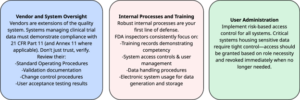
Three key areas will determine your success in achieving the level of compliance needed for a successful inspection: vendor and system oversight, internal processes and training, and user administration (see Figure 2).
Figure 2: Effective Compliance Relies on Vendor Oversight, Robust Internal Processes and Training, and Strict User Administration to Ensure Data Integrity and Inspection Readiness
Avoiding Three Critical Pitfalls
Pitfall #1: Inadequate Vendor Oversight—Don’t assume your vendor is compliant—verify it. Request comprehensive 21 CFR Part 11, European Union Good Manufacturing Practice (EU GMP) Annex 11, and GDPR compliance documentation before implementation, not during an inspection.
Pitfall #2: Weak Internal Processes—Having great technology means nothing without clear processes for using it. Develop comprehensive guidance for staff and maintain evidence that systems work as intended.
Pitfall #3: Inexperienced Site Staff—One of the most significant yet overlooked risks to inspection readiness is having inexperienced staff conducting critical activities. New coordinators, sub-investigators, or support staff who haven’t been through regulatory inspections can unknowingly create compliance gaps that become major findings during inspections. Implement regulatory foundation training to provide everyone with a baseline for regulatory expectations. Assign mentors to inexperienced site staff to provide on-the-job training in preparation for regulatory inspections. Assess knowledge periodically during mini mock inspections and determine the next steps based on their level of familiarity and confidence. One size does not fit all, and this flexible approach allows fast learners to level up while others can dig deeper into the material until competence is established.
The Bottom Line
Inspection readiness isn’t a destination; it’s a journey of continuous improvement. By embracing electronic tools that meet 21 CFR Part 11 and EU GMP Annex 11 standards, maintaining comprehensive documentation, and fostering a culture of quality aligned with GCP guidelines, you transform inspections from feared events into opportunities to showcase your excellence.
Remember, at its core, inspection readiness is about two fundamental principles: protecting study participants (21 CFR Part 50) and ensuring data integrity (21 CFR Part 11, GDPR). Everything else supports these critical goals.
The question remains: Are you ready for a clinical trial inspection tomorrow?
With proper preparation, the right technology, and commitment to these principles, you can confidently answer “yes”—not just tomorrow, but every day.
References
- FDA Inspection Data, Bioresearch Monitoring Program, Fiscal Year 2024. https://www.fda.gov/science-research/clinical-trials-and-human-subject-protection/bimo-inspection-metrics
- ICH E6(R3) Good Clinical Practice: Integrated Addendum, 2025. https://database.ich.org/sites/default/files/ICH_E6(R3)_Step4_FinalGuideline_2025_0106.pdf
- FDA Guidance for Institutional Review Boards and Clinical Investigators, 2020. https://www.fda.gov/regulatory-information/search-fda-guidance-documents/institutional-review-boards-frequently-asked-questions
- https://www.fda.gov/drugs/news-events-human-drugs/joint-us-fda-mhra-uk-health-canada-good-clinical-practice-pharmacovigilance-compliance-symposium

Marc Wartenberger is Vice President for Compliance and Security at CRIO, a health technology company based in Boston, Mass.