
Clinical Researcher—October 2026 (Volume 40, Issue 5)
PEER REVIEWED
Vaidehi Agrawal, PhD
Inclusive clinical trials are increasingly recognized as a critical determinant of both scientific validity and commercial success in clinical product development. This article examines how inclusivity is essential to the ultimate broader clinical success of any novel therapeutics. The COVID-19 pandemic accelerated adoption of decentralized and hybrid trial models, demonstrating how reduced participation burden and expanded geographic reach can improve access and engagement.
Beyond access, clinical registries are explored as foundational tools for identifying suitable patient populations, supporting genetic and molecular stratification and extending research into traditionally underrepresented settings. When integrated with decentralized trial capabilities, registries can evolve into trial-ready ecosystems that embed inclusivity into site networks and operational execution.
The article concludes that strategic partnerships, capable of aligning global development objectives with local healthcare realities, are essential for translating inclusive trial design into reliable, generalizable, and clinically meaningful evidence with the power to provide new therapeutics to support clinical practice.
Background
Inclusive clinical trials sit at the intersection of science and commercial success, playing an important role in how reliably new therapies perform once they leave the controlled environment of clinical development and enter real-world care. In this context, inclusive trials are those that are intentionally designed and executed to ensure meaningful participation from diverse patient populations, across geography, socioeconomic context, and biological or genetic variability, so that the evidence generated is both generalizable and clinically relevant.
The risks of failing to do so are well illustrated by the early clinical experience with Warfarin, an anticoagulant widely used in atrial fibrillation. Approved in 1954, Warfarin{1} entered the market with dosing informed by achieving an international normalized ratio (INR) between 2.0 and 3.0. While effective in the populations studied, subsequent real-world use revealed markedly higher rates of hemorrhagic and thromboembolic events among individuals of Asian descent. Over time, it became clear that the original clinical trials had been conducted primarily in patients of European ancestry, limiting the applicability of the dosing guidance across broader populations. Persistent safety concerns eventually prompted a follow-up trial in 1990, and in 2007, the U.S. Food and Drug Administration approved lower INR-based dosing recommendations for Asian patients.
This experience highlighted a fundamental limitation of traditional clinical development approaches (i.e., when trial populations lack sufficient diversity, clinically meaningful differences, whether driven by biology, genetics, or context of care, can remain hidden until after approval). In response, regulators began placing greater emphasis on representative trial enrollment, culminating in the Omnibus Reform Act of 2022, which introduced formal provisions to strengthen diversity and inclusion in clinical research.{2} These developments signaled a shift in thinking—away from treating inclusivity as a corrective measure and toward recognizing it as an essential component of generating safe, robust, and broadly applicable clinical evidence.
Decentralized Trials: How COVID-19 Taught Us to Be More Inclusive in Clinical Trials
Access remains one of the most persistent barriers to inclusive clinical research. Long before diversity became a formal regulatory priority, many patients were excluded from trials simply because they lacked proximity to a trial site, the ability to travel frequently, or the flexibility to accommodate rigid visit schedules, ultimately resulting in commercial failure of specific therapeutics within specific markets.
During the COVID-19 pandemic, researchers were forced to rapidly rethink the traditional onsite interventional trial model, given that it was impractical or unsafe, and pivot to the decentralized and hybrid approaches that brought research activities into patients’ homes (see Figure 1). What began as a necessity quickly revealed itself as an opportunity. Remote consent, direct-to-patient drug shipment, at-home swabbing, dried blood sampling, and virtual monitoring not only sustained ongoing studies but also expanded access to more diverse populations that had historically remained outside the reach of traditional trial infrastructure.{3} These practices eventually contributed to the normalization of in-home diagnostics such as Lucira and subsequent Pfizer COVID-19 and influenza home tests.
Within a year, large, well-conducted decentralized and remotely executed studies demonstrated that, despite early signals in limited and non–geographically diverse populations, hydroxychloroquine was clinically ineffective and lacked broad clinical applicability.{4–6} This stands in contrast to the historical experience with Warfarin, which was approved based on trials conducted largely in patients of European ancestry and only later encountered significant safety and dosing challenges when used in more diverse populations. The hydroxychloroquine example illustrates how more rapid and broadly accessible adaptive clinical research approaches can help resolve questions of effectiveness earlier in development, whereas insufficient population diversity, as seen with Warfarin, can defer clinically meaningful risk–benefit insights until after approval.
With this, perhaps most importantly, decentralized trials reframed inclusivity as an operational choice rather than an aspirational goal. When thoughtfully implemented, remote and hybrid models allow trial sponsors to reduce participation burden, expand geographic reach, and engage patients on terms that better align with their daily lives, making inclusivity a natural outcome of better trial design and clinical generalizability a natural endpoint.
Figure 1: Conceptual Schematic of a Decentralized Clinical Trial Model
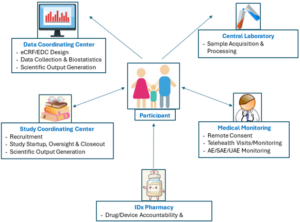
The figure illustrates a decentralized clinical trial in which study activities occur across distributed settings, supported by remote connectivity, local clinical and laboratory services, wearable technologies, and direct-to-patient drug delivery. Data from these sources are securely transmitted to centralized coordination and data management systems, enabling continuous oversight and trial conduct across geographically diverse populations.
Identifying Suitable Patient Populations: The Role of Clinical Registries
As precision medicine mandates more biomarker- or genetic profile–driven patient eligibility, clinical registries serve as an ideal platform for more targeted and efficient recruitment and avoidance of trial failure. Unlike interventional trials, registries can be established and maintained with relatively lower costs and fewer operational demands.{7} This makes them particularly well suited for smaller, rural, and resource-limited healthcare centers. With this, over the past decade, registries spanning a wide range of therapeutic areas have grown substantially, creating large, voluntary datasets that capture demographic characteristics, clinical diagnoses, comorbidities, genetics, and longitudinal health outcomes across diverse populations.
Leveraging the information contained in these registries, clinical trials can rapidly identify and engage patients meeting eligibility, recruit these individuals with more targeted strategies, and ultimately achieve the anticipated study outcome more rapidly with lower costs.{8} This is specifically useful when inherent concentration of a specific diagnosis is noted within niche populations, such as the greater prevalence of community-acquired MRSA in South Texas relative to nationally.{9} Further, clinical trialists can leverage the registries’{10} inherent site network to identify sites that may, with additional support, be set up to house traditional or decentralized support sites for trial implementation with lower cost/higher efficiency clinical implementation.
A natural byproduct of broader patient engagement is more frequent patient-researcher engagement that can naturally begin to build trust in communities which typically distrust or are skeptical of clinical research due to misinformation, ill-founded beliefs, or historically founded beliefs which may no longer be valid.
When thoughtfully integrated into broader trial strategies, clinical registries move beyond data collection tools to become engines of inclusion, connecting diverse patient populations to research opportunities that reflect both scientific intent and real-world need. When thoughtfully aligned, registries and decentralized trial capabilities can evolve into trial-ready ecosystems—networks that not only accelerate study start-up and enrollment but also embed inclusivity into the fabric of clinical development (see Figure 2).
Figure 2: Framework for Inclusive Clinical Trial Design and Execution
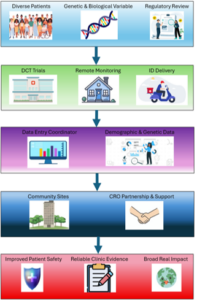
The figure depicts an integrated model encompassing inclusive trial design, access expansion through decentralized and hybrid approaches, registry-based patient identification, and activation of distributed trial networks. These components support improved patient safety, generation of reliable clinical evidence, and enhanced real-world applicability of trial outcomes.
Why Partnerships Ultimately Shape Inclusion
Operational shifts coupled with intentional inclusivity should ultimately be pursued within the context of the evolving global clinical development landscape. According to the 2025 Drug Discovery Market Report, North America currently accounts for approximately 35% of total early-phase drug discovery and development investments, translating to nearly half of all Phase I and II trials, with the Asia-Pacific region holding the majority of Phase III and IV studies. In late 2025, the APAC region (specifically India, Japan, Singapore, South Korea, and China) began experiencing rapid growth in early-phase drug discovery and development, driven by increased funding and evolving regulatory frameworks.{11}
Inclusivity must be intentionally embedded into trial design, site strategy, and operational execution from the outset. Sponsors increasingly require partners that can operate seamlessly across regions, align global scientific objectives with local healthcare realities, and adapt trial models to accommodate diverse patient populations.{10} This includes the ability to activate and support geographically dispersed sites, implement decentralized and hybrid trial approaches, and maintain consistent quality and regulatory compliance across markets.
Equally important is the capacity to integrate multiple sources of evidence, including clinical trial data, registry insights, real-world data, and genetic or biomarker information, into a cohesive development strategy. Organizations that have built long-standing global investigator networks, data coordination expertise, and experience supporting both interventional studies and large-scale registries are uniquely positioned to bridge gaps between access and representation. Their role extends beyond execution, serving as strategic collaborators that help sponsors navigate cultural, linguistic, and operational complexity while sustaining patient engagement throughout the research lifecycle.
Conclusion
As clinical development becomes more global, decentralized, and data-driven, inclusive trials will increasingly distinguish programs that succeed from those that struggle to translate efficacy into real-world impact. The ability to design and deliver trials that reflect the diversity of the populations they intend to serve is a defining factor in generating credible, generalizable, and ultimately meaningful clinical evidence.
Acknowledgement
Special gratitude to Amodh Basavaraj Menasinahal, a rising senior at Plano East Senior High in Plano, Texas, whose curiosity, discipline, and commitment to learning exemplifies the next generation of leaders in medical research and medicine.
References
- Asiimwe IG, Pirmohamed M. 2022. Ethnic Diversity and Warfarin Pharmacogenomics. Frontiers in Pharmacology 13:866058. https://www.frontiersin.org/journals/pharmacology/articles/10.3389/fphar.2022.866058/full
- Wouters OJ, Kesselheim AS. 2024. Quantifying Research and Development Expenditures in the Drug Industry. JAMA Network Open 7(6):e2415407. https://jamanetwork.com/journals/jamanetworkopen/fullarticle/2820566#google_vignette
- Stewart J, Krows ML, Schaafsma TT, Helms DA, Pappas AJ, Johnson CC, Fessel JT, Peck ME, Karnes RE, Schmidt JP, Waterer GW, et al. 2022. Comparison of Racial, Ethnic, and Geographic Location Diversity of Participants Enrolled in Clinic-Based vs 2 Remote COVID-19 Clinical Trials. JAMA Network Open 5(2):e2148325. https://jamanetwork.com/journals/jamanetworkopen/fullarticle/2789002
- ClinicalTrials.gov. Efficacy of Hydroxychloroquine for Post-Exposure Prophylaxis (PEP) to Prevent Severe Acute Respiratory Syndrome Coronavirus 2 (SARS-CoV-2) Infection Among Adults Exposed to Coronavirus Diseases (COVID-19): A Blinded, Randomized Study. ClinicalTrials.gov Identifier: NCT04328961. https://cdn.clinicaltrials.gov/large-docs/61/NCT04328961/SAP_001.pdf
- Li C, Cheng G. 2020. Will Hydroxychloroquine Still Be a Game-Changer for COVID-19 by Combining Azithromycin? Frontiers in Immunology 11:1969. https://pubmed.ncbi.nlm.nih.gov/32849658/
- Li X, Wang Y, Agostinis P, Rabson A, Melino G, Carafoli E, Shi Y, Sun E. 2020. Is Hydroxychloroquine Beneficial for COVID-19 Patients? Cell Death & Disease 11(7):512. https://pubmed.ncbi.nlm.nih.gov/32641681/
- Lu Y, Li S, Lawrence S, Kaur S. 2024. Technology-Enabled Real-World Data and Clinical Research Data Integration in a Clinical Registry Ecosystem for Foundations. Applied Clinical Trials. https://www.appliedclinicaltrialsonline.com/view/technology-enabled-real-world-data-and-clinical-research-data-integration-in-a-clinical-registry-ecosystem-for-foundations
- Briel M, Elger BS, McLennan S, Schandelmaier S, von Elm E, Satalkar P. 2021. Exploring Reasons for Recruitment Failure in Clinical Trials: A Qualitative Study with Clinical Trial Stakeholders in Switzerland, Germany, and Canada. Trials 22(844). https://pubmed.ncbi.nlm.nih.gov/34823582/
- Forcade NA, Parchman ML, Jorgensen JS, Du LC, Nyren NR, Treviño LB, Peña J, Mann MW, Muñoz A, Treviño SB, Mortensen EM, Wickes BL, Pollock BH, Frei CR. 2011. Prevalence, Severity, and Treatment of Community-Acquired Methicillin-Resistant Staphylococcus aureus (CA-MRSA) Skin and Soft Tissue Infections in 10 Medical Clinics in Texas: A South Texas Ambulatory Research Network (STARNet) Study. Journal of the American Board of Family Medicine 24(5):543–50. https://pmc.ncbi.nlm.nih.gov/articles/PMC3258020/
- Shiely F, O’Shea N, Murphy E, Eustace J. 2024. Registry-based randomised controlled trials: conduct, advantages and challenges—a systematic review. Trials 25(375). https://link.springer.com/article/10.1186/s13063-024-08209-3
- Popli AR, Zhang F, Park J, Le Deu F. 2026. The Emerging Epicenter: Asia’s Role in Biopharma’s Future. McKinsey & Company. https://www.mckinsey.com/industries/life-sciences/our-insights/the-emerging-epicenter-asias-role-in-biopharmas-future

Vaidehi Agrawal, PhD, is Director of Health Programs and a Consultant for the University of Maryland Baltimore.