
Clinical Researcher—December 2025 (Volume 39, Issue 6)
PRESCRIPTIONS FOR BUSINESS
Contributed by the members of a 2025 Innovation Network Gathering (ING) working group*
Clinical research professionals working for study sites, clinical research organizations (CROs), and sponsors share a commitment to developing medications, medical devices, and other treatments designed to improve and extend quality of life. Over the years, this collaborative team has defeated or mitigated COVID-19, HIV, polio, and hundreds of other diseases and health afflictions. It’s a higher calling, and we as a clinical trial industry should be proud of these and other accomplishments.
But at the same time, as an industry we aren’t living up to our highest potential—and it is the patients who endure the consequences of delayed new treatments and inefficient clinical trials that don’t always represent the full population.
Yes, we’ve made some strides in the right direction. But frankly, we aren’t improving fast enough as an industry.
In this article, we’d like to address a core problem undermining our peak performance: Namely, transactional site-CRO-sponsor relationships hinder trial performance by misaligning risk, responsibility, and reward, thereby damaging the trust and continuity required for sustained results.
We’d also like to demonstrate how the benefits of multisite clinical research corporations (MCRCs) could go a long way toward addressing or even solving many of these most stubborn challenges in the clinical trial ecosystem.
We recently had a unique opportunity at the 2025 ING conference: Representatives from three key segments of the clinical trial ecosystem sat down in the same room for two days and discovered the value of talking with and not at each other. Here are some other things we learned—and some solutions we developed—during our days of discussion as we worked together to evolve our working relationships from transactional to strategic.
Getting at the Root Causes of Sluggish Progress
During our group discussion with team members from sites, CROs, and sponsors together in the same room, we quickly determined one root cause slowing our progress is the lack of consistent governance and strategic alignment between these three arms of the industry.
Each sponsor and CRO operates under its own governance model—often unique to a study, protocol, or therapeutic area—which results in a highly fragmented system with little standardization or continuity. These governance models are typically study-specific and tactical, designed to serve immediate needs rather than to foster long-term collaboration or shared learning. As a result, relationships across the ecosystem remain transactional, inconsistent, and dependent on individual personalities rather than on institutional frameworks.
It’s as if we start from scratch with each study when we should strive for consistency and build on best practices.
Sponsors and CROs, by virtue of their control over funding and resources, dictate how studies are designed, initiated, and distributed. However, their focus on individual investigators (through mechanisms like the “Statement of Investigator” Form FDA 1572) limits their ability to view sites as strategic partners. This “doctor-first” mindset prevents sponsors from recognizing the full operational and data capabilities that large MCRCs bring to the table.
Unfortunately, studies are all too often dispersed on a one-off, tactical basis. Site selection is often algorithmic or based on legacy relationships rather than performance data or strategic fit. The consequence is a cycle of misaligned risk, responsibility, and reward in which trust, predictability, and accountability remain elusive.
Today’s sponsor–site relationships resemble arranged marriages formed for convenience, short-term execution, and compliance rather than for shared vision, trust, and long-term growth. True progress, the working group participants agreed, requires a transition toward relationships that are built intentionally, nurtured over time, and anchored in mutual goals, transparency, and governance.
Several additional factors exacerbate this fragmentation. Complex study protocols drive burnout among site staff. Sponsors and CROs install different technologies at sites without understanding the operational burden. Even when standards exist, relationships still dominate decision-making, meaning progress is often personality-driven rather than process-driven.
In Search of Solutions
In exploring solutions, we agreed that governance should not be tied to individuals but to standardized systems and shared principles. Standardized training and common governance frameworks could create more predictable, efficient working relationships. Sponsors and CROs should begin involving sites earlier in protocol design, enabling them to contribute to feasibility and operational planning.
Another big problem is that sponsors and CROs don’t have processes set up between them that cover site interactions, site escalations, shared databases, or even delineations of rules and responsibilities on things like approving site-initiated trial advertising without massive delays.
As we dug deeper into these and other challenges, we also discussed how predictability could be improved for each stakeholder:
- For sites: maintain real-time data on capabilities and pipelines, ensure visibility of upcoming studies, and establish transparent, goal-based communication with sponsors and CROs.
- For CROs: define global business agreements, set measurable key performance indicators, improve responsiveness, and use scorecards to benchmark performance.
- For sponsors: focus on trust-building through follow-through on commitments, transparent timelines, proactive risk mitigation, and visibility into how sites actually operate.
Finally, we agreed that two engagement tracks must run in parallel: a tactical model for individual studies and a strategic model that fosters portfolio-level partnerships. The latter should be underpinned by standardized governance, ongoing relationship management, and shared accountability for outcomes.
In essence, we concluded that the industry must move from transactional to trust-based partnerships in which governance, standardization, and collaboration create a foundation for reliability, predictability, and performance across the entire clinical trial ecosystem.
We Can See Clearly Now
It was exciting—and frankly, eye-opening—for each of us to sit down with the others for two days to vent, dream, and come up with solutions to age-old problems. It’s absolutely vital for each member of the clinical trial process to have a better understanding of the challenges facing other aspects of the ecosystem. We learned it was possible to cut through old biases and inertia and find new ways to better harness our shared passion.
In the hustle and bustle of our busy professional days, it’s easy to sometimes forget why we got into clinical trials. Working together, we can reignite our commitment to making human life better.
Contributors
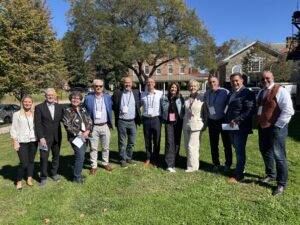
*This article is based on the deliberations of an October 2025 working group whose members met at the Innovation Network Gathering in West Chester, Pa., including (from left to right) Meghan Varano, Associate Director, Business Development/Atlas Clinical Research; Mark Scullion, CEO/Atlas Clinical Research; Maria Ladd, Co-Founder/Clinical Research Site Collective; Sean Cunningham, Senior Director, Study Site Engagement/Takeda; EB McClindon, CEO/Helios Clinical Research; Wouter Daniels, Patient and Site Engagement Lead/Boehringer Ingelheim; Gerri Gallagher, Senior Director, U.S. Site Engagement/GlaxoSmithKline; Karen McIntyre, Vice President, Site Alliance and Patient Recruitment/Parexel; Dan Schell, Chief Editor/Clinical Leader; Carlos Orantes, CEO/Alcanza Clinical Research; Jeff Kingsley, Chief Development Officer/Centricity Research; and Christine Senn, Senior Vice President, Site-Sponsor Innovation/Advarra (not pictured).